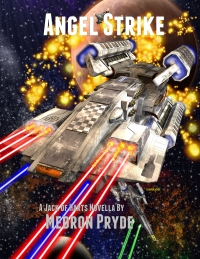
The F-101 Fury used an innovative laser system that many thought would revolutionize the weapons industry. Instead of installing multiple laser arrays like other fighters, they deployed a ring of laser emitters around the nose of the craft using a single power source. That gave them a wide firing arc, and the ability to fire multiple low-powered shots at once. This could generate an impressive light show that was effective for point defense purposes, but it was of little use when dealing damage to enemy starfighters. Later designs simply installed multiple laser arrays, but the F-2 Star Fury kept the ring-array lasers through their upgrade plans and into retirement. When the Texas Rangers eventually pulled the Star Furies out of retirement, they installed far more powerful modern generators and a capacitor system capable of powering a focused maximum firepower attack from the entire array at once. Their targets found that quiet impressive, for a few seconds…
One of the more fundamental changes the Texas Rangers made to the F-2 Star Fury was a reduction in the massive series of fuel tanks that fed the rocket engines of the old F-101 Fury. Pre-War fusion torch drives were far more fuel efficient than those Pre-Contact rockets, so the Rangers could remove multiple tanks while still receiving fighters with longer legs than their older cousins. The Rangers then created a small living and storage space behind the cockpit, allowing the Rangers to step back from the controls and relax during long interplanetary patrols. The storage locker was large enough to store the Ranger’s personal arms and armor, and a separate bay in the Star Fury’s belly housed a small jeep for planetary patrolling. Yes, the Ranger Star Fury could fight well, but the Rangers wanted a patrol craft, and many consider it one of the best patrol craft ever fielded by the Republic of Texas.
The F-101 Fury was one of the most advanced fighters of its day. Then the Peloran made Contact and it became obsolete overnight. Texas upgraded it with gravtech, and it became the F-2 Star Fury, the first of America’s newest generation of starfighters. It retired in time, as newer technologies made their way into new starfighter designs. The Texas Rangers eventually found those abandoned fighters and scooped them up for their own use with a refit program that would carry them into the next century. Most of the updates were fairly minor, including newer scanners and improvements to the ring laser surrounding the nose. Others were more fundamental, like the complete replacement of the old missile systems with brand new racks and expanded ammunition bunkerage that allowed for far more versatility. The Rangers gave a new lease on life to an aging design.
The Texas Ranger Abilene-class starships were fully upgraded to the best of our technology before The War. They received full Peloran tech during that conflict and further modifications have improved their performance since War’s End. They now boast the very best hyperdrive and inertial compensator technologies from both the Peloran and Texas technological trees. Modern engines generate far more thrust than the old, ancient engines of the pre-gravtech era, while maintaining the same silhouette as older Abilenes. They are small ships with big engines that can accelerate far faster than most other ships. And their Peloran hyperdrives can go deeper into hyperspace, where that speed advantage is further reinforced. Unofficial estimates suggest they can travel 150% faster than a front line American Navy squadron. The Texas Rangers do not comment on their actual top speed, maintaining it as an official secret of the Republic of Texas. But they are one of the fastest ships in space.
The Abilene-class starships that carry Texas Rangers across the stars are different from those that once sailed the void. The crew quarters that once served 150 tightly-packed crew and scientists have been reduced to a handful of single-occupancy quarters for the cybernetic crew and their assigned Ranger. The remaining space primarily houses holding cells and storage for relief supplies, weapons, armor, and other equipment. An Abilene carries enough supplies for a Ranger to outfit a posse of any conceivable size, or to bring relief to a community leveled by a natural disaster. Rangers are often the first to arrive after such incidents, making a well-provisioned Abilene a welcome sight wherever disasters occur throughout known space.
Forge of War on Amazon
Angel Flight on Amazon
Angel Strike on Amazon
Angel War on Amazon
Wolfenheim Rising on Amazon
Wolfenheim Emergent on Amazon