Kings Bay in Georgia had been a ballistic missile submarine base for over half a century when the Second Great Depression began. The crews were famous for remaining underwater, acting like holes in the ocean, for months on end. Always ready to fire missiles that could end civilization as we knew it. Aware that if the balloon ever went up, they could be the last surviving Americans in the world. Or that some Soviet or Chinese attack submarine could kill them before they knew it. Mutually Assured Destruction was the entire basis of their existence. They hoped they would never be required to fire their weapons, but if they did, they would kill as many Soviets, Russians, Chinese, or whatever the target of the decade was. Then one of their number fired missiles on America. On Virginia. The worst part for the crews of Kings Bay is that the crew that fired on home was not a phantom threat to them. They knew each other. They went to the bars together. Many had served on every boat. They were faces and names and friends. And then other Americans killed them after they followed the worst orders in the world. It is impossible to underestimate how that affected them.
There were three American submarine bases on the East Coast when the Second Great Depression began. New London in Connecticut, Kings Bay in Georgia, and Norfolk in Virginia. The sinking of USS Georgia after it fired nuclear missiles on Virginia would have drastic effects on all three bases. Connecticut would join the New England Federation when it formed, just as Georgia and Virginia would join the Confederation of Dixie in time. But the submarine service was united in its wish to not be ordered to fire on Americans again. No matter which flavor of Americans they were. Which is why, once the Convention of States reformed the Federal government, the submarine bases became joint commands of the States they resided in and the new Federal government. With the binding agreement that they would never be deployed against any other American State. Ever. Under any circumstances.
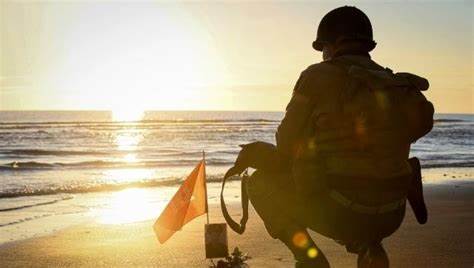
This has been a long week. Starting with Memorial Day and going on to the anniversary of the D-Day landing that started the end of the Third Reich. There is a lot of sacrifice we remember this week. Lives ended while fighting for the world we live in now. Two entire American generations have grown up never seeing fully-mobilized war, thanks to those we remember this week. Thanks to this fateful day on Normandy. Never Forget.
The Kings Bay submarine base in Georgia had a difficult Second Great Depression. The entire United States Navy ballistic and cruise missile submarine force was homeported at Kings Bay. It was a powerful force, capable of devastating any nation on Earth. One of their submarines, USS Georgia, followed Federal orders and fired those nuclear missiles at Virginia. Nobody knows why their missiles did not detonate, and we probably never will. A nearby attack submarine, ironically the USS Virginia, sunk the Georgia with torpedo fire immediately after the larger boat began firing her missiles. That kept the Georgia from firing the full volley most military historians believe she was attempting to fire, and removed all chances of finding out why her crew executed the order in the first place. It was a horrible blow to both the tight-knit submarine fleet, and to Kings Bay itself. They had all known that they were meant to fight America’s enemies. The fact that they had been ordered to kill Americans, and that one of them had actually attempted to do so, shook them all to the core of their beings. That attack would change America’s submarine service forever.
Wilmington, North Carolina had long been home to various Coast Guard cutters, usually named Diligence, long before the Second Great Depression began. The last of them had departed for Florida decades before due to the changing nature of the Coast Guard’s mission, but when that ship was retired, Wilmington purchased her and brought her home again. They kept her seaworthy, took her out on celebrity cruises, and generally treated her as the city’s most welcome guest and attraction. Then the Second Great Depression began, and North Carolina realized it required a navy of its own. They had very little to work with. They were no longer blessed with major United States naval bases, but they did have multiple Navy and Coast Guard reserve stations, filled with naval reservists looking for a what to serve their State. And they had Diligence. That was how a 210 foot retired Coast Guard cutter became the flagship of a major American State Navy. She did not serve in that capacity for long. They acquired better ships in time. But she was the first flagship of the North Carolina Navy, and Wilmington does not let anybody walk by her dock without telling them of that fact.

Forge of War on Amazon
Angel Flight on Amazon
Angel Strike on Amazon
Angel War on Amazon
Wolfenheim Rising on Amazon
Wolfenheim Emergent on Amazon