The Republic of Texas Marine Corps are not infantry. Ask them. They will be quick to disabuse you of that notion. They are Marines. They are trained to fight in space or on ground. They are trained in High Altitude Low Orbit drops from starships aboard assault shuttles, mechs, tanks, jeeps, cycles, or simply wearing the powered battle armor that is their uniform. When the fleets hold the orbitals, when the Army is planning an invasion, the Marines go in first to secure the landing zone, often in the face of planetary defense grids that do not wish them to come down alive. It is often Marine attack craft or starfighters that dive down with them, smashing the defenses or taking fire for their brothers and sisters. The Marines did this in countless small actions of the various brushfire conflicts out in the colonial regions that no major nation admitted went on. They ramped up during the Hyades Campaign and filled the skies with HALO Marine drops across the cluster.
The Republic of Texas Marine Corps has been an odd organization since the beginning of the Republic. Part light infantry. Part mobile infantry. Part naval infantry. Part diplomatic guard. Some are lawmen. Some fight in air and space. All wear powered battle armor. Every Marine is a rifleman. They consider themselves the premiere Texas ground, air, and space combatants. The Space Force and the Army disagree with them. The Navy laughs in capital missiles. But it is undeniable that there is a certain mythos to being a Texas Marine that is larger than life. They have much in common with the Texas Rangers in that. They are relatively few in number compared to the other services, but their deeds are the stuff of legends. And wherever the Texas military goes in any numbers, you can expect at least some Texas Marines to be part of that force. Sometimes they are the entirety of the force.
The Republic of Texas Space Force designed and deployed the F-23 Super Sabre not long after War’s End. It incorporated all of the lessons Texas had learned during The War into a single fighter that could, theoretically perform any mission assigned to it. The laser and missile arrays could engage in everything from ground attack to space superiority missions, while the single spinal gravitic cannon could penetrate even warship deflection grids when operating in squadron strength. The Super Sabre was the largest fighter in widespread usage, due largely to the small living space hidden behind the cockpit. Texas planned to use it for extended interstellar patrols, and wanted their pilots to arrive rested and ready to fight. The Super Sabre quickly became the dominant multi-role starfighter in Texas service, a position it maintained to good effect with consistent minor and major updates over the decades of peace we saw after War’s End.
The Republic of Texas Space Force operated the B-17 Valkyrie throughout The War, with successive point updates to cover up deficiencies in the rushed design. They promised an upgraded production version every year as The War continued, but retooling was difficult and the lost production time would have badly affected deployment. So they continued to build the Valkyries until they drove the Shang from the Hyades Cluster. Only then did Texas authorize the construction of the new B-25 Super Valkyrie that included every major update and lesson learned during the Valkyrie’s two decades of front line service. The first of them technically saw service before War’s End, but most military historians consider them a Post War design, as they saw no major combat actions. Very few were built before War’s End, and the factories were shut down afterwards. Those Super Valkyries, and the many Valkyries rebuilt to their standard, became Texas’ primary bomber in the decades of peace that followed.
The Republic of Texas Space Force greatly wished a new series of homegrown hypercapable attack and fighter craft to go along with their Valkyrie bombers. Texas was getting its Texas on when it replaced the older Vigilante’s autocannons with gravitic cannons and renamed it the A-10 Righteous Vigilante. It was a mouthful of a name that was quickly truncated by almost everybody. The absolutely new F-15 Sabre sported a quartet of missile launchers along with a single gravitic cannon so it could handle more mixed missions. Both designs received their baptism of fire in the Hyades Cluster, where mixed hypercapable forces quickly moved through the close systems of the Hyades Core in a serious of feinting and slashing assaults. It is one of the crowning moments of Space Force history that they drove this campaign clear through to War’s End.
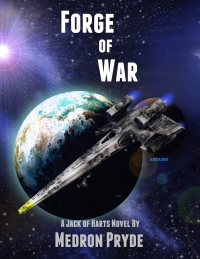
Forge of War on Amazon
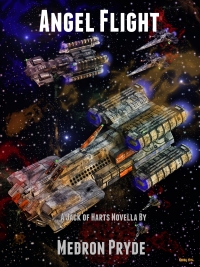
Angel Flight on Amazon
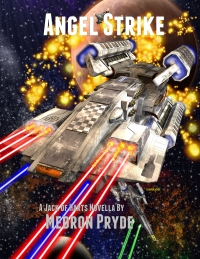
Angel Strike on Amazon
Angel War on Amazon
Wolfenheim Rising on Amazon
Wolfenheim Emergent on Amazon