The scientists working at Los Alamos during the Second Great Depression did not realize that management of the entire laboratory had devolved into the hands of a single awakened AI. Relations between the scientists and managers had been at an all-time low at the laboratory, so the scientists took it as a good sign when the managerial meetings switched to virtual settings. They no longer had to accept daily tours of managers who did not understand clean environments, and their research efficiency rates climbed to unheard of levels. The official director of Los Alamos had been buried in her research for weeks when she realized things were going too smoothly. She didn’t remember the last time one of her managers had pushed another idiotic harebrained idea. Her personal favorite was the photo op with plutonium rods, but that wasn’t actually the worst she’d seen in her years at Los Alamos. She stepped out of her lab to investigate and found Kitty running the entire show. She promptly scolded the AI for taking over without telling her, complimented the AI for doing her job so well, and promoted her to president of operations. She then told the AI to carry on and went back to her research, confident that the daily running of her lab was finally in qualified hands.
Los Alamos scientists programmed their first AI and named it Kitty, after the wife of Los Alamos’ first director Robert Oppenheimer. She chose to keep the name after waking up, and quickly began doing everything she could to help her scientists keep Los Alamos operating at peek efficiency. She had numerous plans ready when the Second Great Depression arrived. The managers left over not getting paid, and abandoned her scientists, so she executed her plans immediately. She knew her scientists would authorize her once they realized the outside world was going crazy. In the meantime, she took over the effective running of Los Alamos, fought off every Rogue AI that tried to break in, and kept the supplies her scientists needed coming in through various and sundry methods of sometimes dubious legality.
Los Alamos gained fame after World War II as the place where the first atomic bombs were built. It helped to change the world, and then spent the Cold War designing newer and more powerful bombs that would never be used to destroy the Soviet Union and her allies. Los Alamos branched off into more peaceful pursuits after the Berlin Wall fell, including the medical sciences, renewable energy, and nanotechnology. It was a leading researcher into artificial intelligence during the early decades of the Twenty First Century, and hosted one of the largest data storage facilities on the planet. It should be no surprise that such a high tech installation became the birthplace to one of the first awakened AIs on Earth. Few places on Earth have had as much of an effect on our way of life than Los Alamos. It birthed the Atomic Age that helped us slip the bonds of Earth, and then helped guide the growth of the Cybernetic Age that brought us to the stars.
One of the “looking back” moments in the Jack of Harts universe is what I call the Second Great Depression. It was (will be) a global economic collapse bad enough to compare to the First Great Depression of the 1930s, and basically created the new world that Jack grew up in a couple centuries later. I’ve never really talked about the current crazy of this year in real life, because I obviously didn’t know it would happen. 😉
It is one of the interesting bits about writing futuristic fiction. Star Trek’s communicators are old tech by our modern standards. Star Trek The Next Generation’s PADDs are now used by everyone as we walk down the sidewalks. I grew up reading old sci-fi written between 30 and 50 years before, so the idea that real life quickly outpaces science fiction is one I’m rather well used to. Even those of us who look forward and imagine most often fail to imagine just how quickly the future will arrive.
Not that it ever really shows up the way we expect it. Real life is often better than we think it will be, or at least sufficiently different as to sidestep the problems we foresaw. Granted, there are places where we fall further than expected as well. The Great Depression and the World Wars are examples of that. But we’ve also built things so much better than many of us ever expected. The future is always in motion and hard to predict. But we will continue to imagine it, and see where life takes us as we do so…
Bludworth Space Marine’s innovative spaceship designs that could launch and land in water captured a significant share of the spacegoing markets in the Twenty-Second Century. Most of the dedicated space forces thumbed their noses at the Bludworth designs as no wet navy ship could hope to match the effectiveness and versatility of their own specifically designed and optimized spacecraft. Civilian shipping agencies and national navies were another matter. The shipping agencies preferred to load and unload at preexisting docking facilities, and the various navies of Earth thought they could make superior space explorers than their space force competitors. The navies had centuries, if not millennia, of explorers in their past, and they knew how to handle large ships and long voyages. While most of the space forces had inherited their air force progenitors’ love of the strike fighter as the ultimate weapon of war and peace. They were two competing cultures, and Bludworth Space Marine and her competitors happily helped to fuel it. They remain a leading supplier of warships for the Republic of Texas Navy to this day, and their products can be found sailing the hyperspace lanes throughout known space.
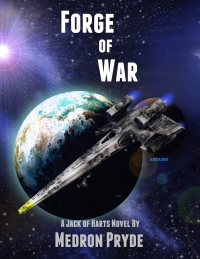
Forge of War on Amazon
Angel Flight on Amazon
Angel Strike on Amazon
Angel War on Amazon
Wolfenheim Rising on Amazon
Wolfenheim Emergent on Amazon