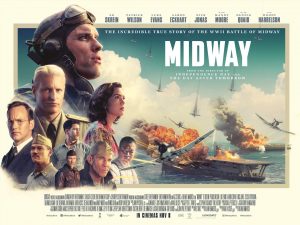
I grew up watching the Charlton Heston Midway, complete with the old shaky newfilm-like airplane action, and always loved it. So when the new Midway came out, I quickly bought the old one on DVD (or possibly Blu Ray, but what’s the difference?) and watched it to refresh my memory. Yes, it suffered from some bad acting, and there were times when the love story was painful. Because of the acting, not the story. But it really was the way a generation has grown up seeing that battle.
The new Midway I think is a reflection of our new world, and fits it as well as the old Midway fit its time. We live in a world where children are not taught our history in school, so a movie about Midway really must build the story up for it to make sense. So of course they start with a diplomatic luncheon before the war to show tensions are on the rise. Then we see the attack on Pearl Harbor, and the American response. The Doolittle Raid. The Coral Sea. We see these in scattershot bullet points in what feels like maybe a half hour at most and cement assembled characters in our minds.
Yamamoto is a genius and a patriot. Perhaps the best ally and worst enemy America has at the same time. William “Bull” Halsey is a dirt grubbing grunt willing to charge into overwhelming odds if that’s what it takes to blunt the Japanese offensive. Dick Best is an amazing pilot in a dive bomber who can do things with his plane that shouldn’t be possible. And that is the secret to the film. It is an ensemble cast full of major actors playing real people that truly existed and trying to bring them to life for all of us to see.
This isn’t a documentary. It’s a Hollywood film, even if put together off Hollywood on a shoestring budget, and so it gets things wrong. Some insignias aren’t accurate, we see a jeep only deployed in England in Hawaii, and some color schemes show up out of real timeline. And some things are more dramatic than they were in real life. Not saying they weren’t scary here, but that in a Hollywood it has to LOOK scarier, and more dramatic than real life because we’ve been raised to expect it in our big budget spectaculars. It is a movie, made to show us a story, and it does so in spectacular fashion.
What is that movie? It is the story of Dick Best and the United States fleet carrier USS Enterprise, with a smattering side-story of Layton and Nimitz at Pearl Harbor trying to get their fleets to the right places with the right intelligence to stop the Japanese. A few brilliant scenes show them just waiting and hoping they got it right. The leaders and intelligence pukes knowing they’ve done everything they can, hoping it was enough, and knowing they’ll never forgive themselves if they didn’t do everything they could. The actors nailed those scenes well.
All while Dick Best and the USS Enterprise take their tour of the Pacific Ocean from Pearl Harbor to the outskirts of Japanese waters, and all the way down to the Coral Sea. We see men die in training accidents and combat, in fluke failures, and crash landings. And then we travel to Midway for the showdown that will determine this phase of the war. The battle hardened and trained squadrons of Hornet, Enterprise, and the recently damaged Yorktown fly beside fresh squadrons shipped into Midway to fight the unstoppable juggernaut that is Japan.
And then we see the Battle of Midway unfold in typical Hollywood, bigger than life, fashion. Though something to consider is that this is the story of Dick Best and Enterprise. The dive bombers and torpedo bombers that attacked the Japanese fleet. We don’t see the fighters that run cover for them. Or the fighters that defend Midway and the carriers. This is a movie about the brave bomber pilots that fought through flak and enemy fighters in an effort to blow up the Japanese carriers that threatened their homes. And while not always historically accurate, it tells their stories well.
It is a beautiful lie that tells the story of a great and terrible battle better than most movies do. Imagine the spectacle of Independence Day crossed with World War II Midway, and you’ll get a good idea of what this movie is like. It is a good and enjoyable movie and I recommend it.
I give it two bombs, making some really fine explosions that rise up into the sky.


 Forge of War on Amazon
 Angel Flight on Amazon
 Angel Strike on Amazon
 Angel War on Amazon
 Wolfenheim Rising on Amazon
 Wolfenheim Emergent on Amazon