The election of 1868 was effectively a war without name. Former Confederate leaders and officers could not vote, while the freed slaves were all but guaranteed to vote in overwhelming numbers for Union General Grant who had helped free them. No Confederates could run for office, so the political tables were balanced between the Republicans advocating permanent suffrage for all freedmen and the Northern Democrats campaigning for the right of States to make their own decisions on who could be allowed to vote. And three States, including Texas, had not yet been welcomed back into the Union, so they could not vote at all. Which in some ways was very good for Texas. They avoided the worst of the political violence that washed through the other Southern States as the Ku Klux Klan hunted down or assassinated thousands of Republicans, burned down churches, schools, and homes, and did everything they could to keep people from picking up a Republican ballot on election day. Grant won despite the campaign of voter suppression and pushed Radical Reconstruction into the Southern States straight to the hilt.
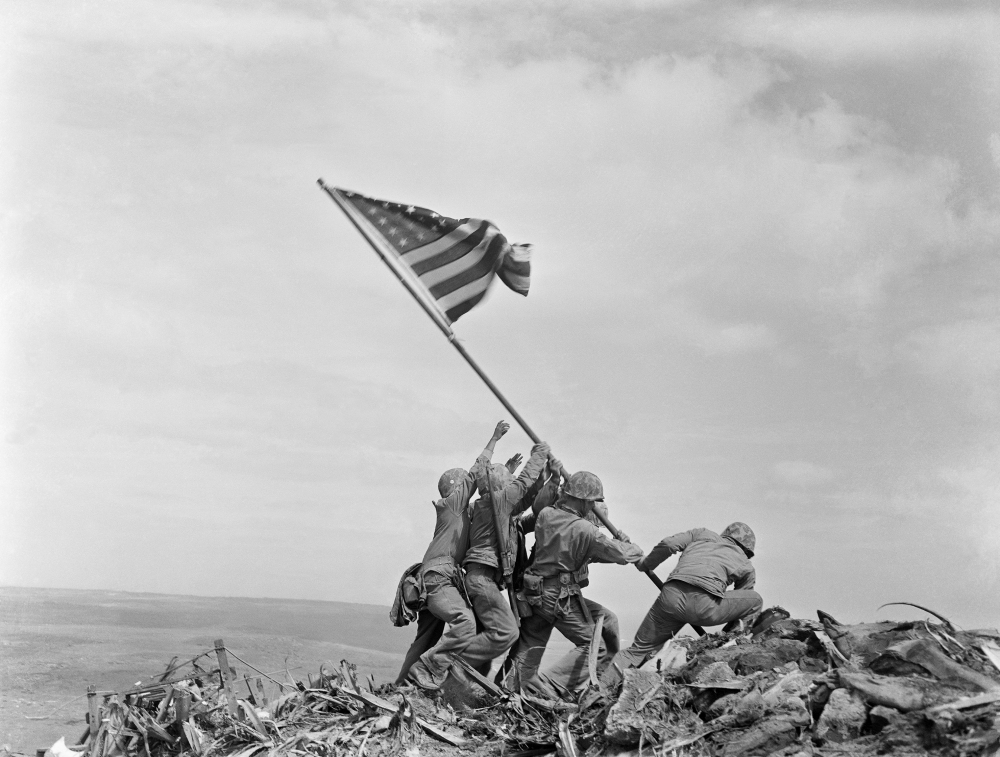
We invaded Iwo Jima seventy-five years ago in our drive to advance to the Japanese Home Islanders during World War II. Over 500 ships and 110,000 men would assault the tiny island. We lost one ship, with two others damaged, and nearly 20,000 of our men were injured. Nearly 7,000 died, including half of those in this immortal picture taken atop Mount Suribachi. It took over a month to kill 18,000 dug in Japanese defenders, and another three months to dig out most of the 3,000 that remained in hiding. The last two Japanese soldiers finally surrendered four years later.
Seventy-five years ago, the photographer nearly missed it because he was busy piling rocks when he realized the flag was going up. He grabbed his camera and snapped the photo without even taking time to look through the viewfinder. He just clicked it, hoped it came out, and his picture became one of the most famous photographs ever taken.
The administration Democrat President Johnson inherited after Republican President Lincoln’s assassination was aggressive in the form of Reconstruction it wanted to pursue. The Republicans wanted to erase Slavery and replace it with a true Free Society forever divorced from the one that came before. Johnson wished a far more modest Reconstruction that would allow the Southern States to map their own futures, and further wished to reshape his administration in his image. So the Republicans passed a law that forbade him from removing anyone the President and the Senate had placed in position without first asking the Senate to agree. When President Johnson dismissed Secretary of War Stanton in a direct challenge to the law they had passed over his veto, the House of Representatives voted to Impeach him. The Senate failed to convict him by one vote, and he remained in office until the end of the term he and Lincoln had been elected to, but his political star had been brought low. Even the Democrats did not want him, and the election of 1868 proceeded on without him.
The Republicans ran the table in the post-victory election of 1866. They achieved two thirds majorities in both Houses, enough to override any vetoes from President Johnson, and quickly suspended the civilian governments in the Southern States. They enacted a five year suspension of voting rights for former Confederate leaders and officers, and passed the Fourteenth Amendment that clearly stated the freedmen were full citizens of the United States, and could not be deprived of their life, liberty, or property without due process and equal protection. It reapportioned Representatives by counting all the free men over twenty five years of age in each State. It banned former Confederates from government service, and wrote off the debts incurred by those in rebellion or insurrection. And in a move that was particularly stunning, it gave Congress itself the power to enforce the Amendment. A power they quickly sought to use as they pressed what historians called the Radical Reconstruction Plan into the Southern States.
The assassination of President Abraham Lincoln changed everything for Reconstruction in the Southern States. He had run the 1864 election with a unity government made up of Republicans and Northern Democrats in an attempt to make the Civil War less of a Republican versus Democrat conflict. Democrat Vice President Andrew Johnson spoke of hanging Confederates while part of the unity government, but as President he sought a much softer Reconstruction. Few Confederate leaders were imprisoned, none were tried for treason, and only one was executed for war crimes. He did not stop the Southern Black Codes that turned the freedmen into second class citizens, unable to own property, do business, or even walk around in public spaces like a normal man, and he blocked many laws the Republican Congress tried to pass. That was poorly received by Republicans, who fought the election of 1866 with a plan to change everything.

Forge of War on Amazon
Angel Flight on Amazon
Angel Strike on Amazon
Angel War on Amazon
Wolfenheim Rising on Amazon
Wolfenheim Emergent on Amazon