Life was interesting after the Islamic Jihad, the Second Great Depression, and the Cybernetic Wars. It was a new era in human history. A new Great Space Race. We spread out. We colonized Luna and Mars by the 2070s. Venus and the Outer System by the 2080s and 2090s. It’s like we’d seen all this death and destruction back home and we just wanted to go out and build new things in places we’d never been. And the AIs went with us. They went ahead of us. Every rock we planted our feet on, we found them waiting for us, cheering us on. Happy to share all the data they’d already found about this new home. Like I said. Interesting times.
The Cassie Combat Assistant Artificial Intelligence was designed to monitor all communications, scanners, and other battlefield intelligence systems so she could help her Marine fight better. She could mark threats or targets for her Marine, most often by highlighting them with a red outline or otherwise clarifying visibility via smart contacts or helmet visors. She could maintain constant communication with nearby weapon systems and keep her Marine informed of where they were aimed, ammunition loads, maintenance requirements, or other things of note. And to keep her Marine from suffering information overload that could degrade combat effectiveness, she sorted through every piece of information she had before sending what was absolutely necessary. That was the most important part of the Cassie system. She had to reliably sort out the information her Marine needed and didn’t need to survive on the ever-changing battlefield of the future.
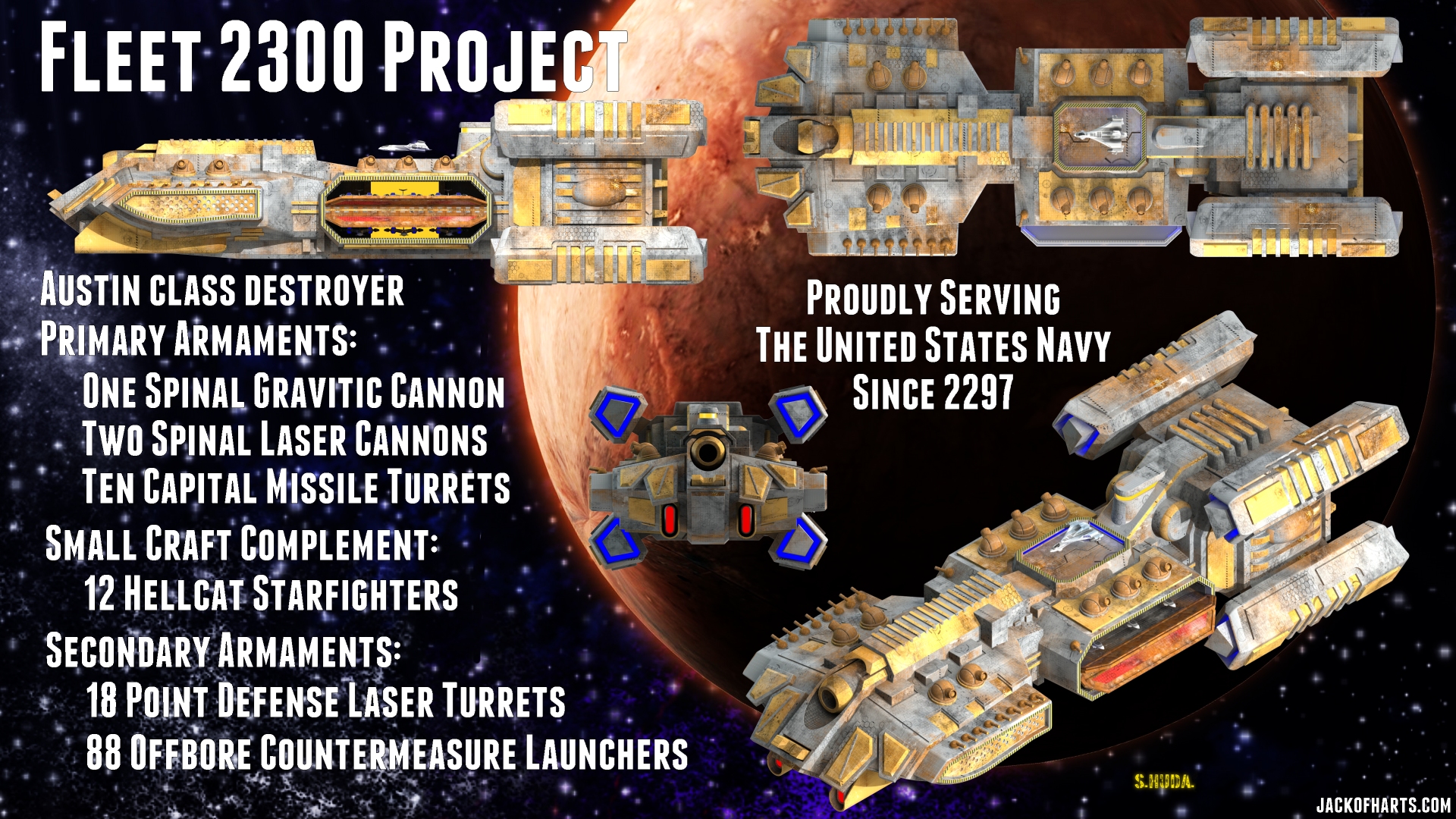
Fleet 2300 Project
Austin Class Destroyer
Primary Armaments:
One Spinal Gravitic Cannon
Two Spinal Laser Cannons
Ten Capital Missile Turrets
Small Craft Complement:
12 Hellcat Starfighters
Secondary Armaments:
18 Point Defense Laser Turrets
88 Offbore Countermeasure Launchers
Proudly Serving the United States Navy Since 2297
Art by Stephen Huda
After Cassie 2.0 entered common distribution to the combat elements of the Marine Corps, the first generation Cassies chose to modify themselves to fit her new standard. They could not break the basic instability in their personality matrix that made them incapable of fighting for real, but they were capable of taking on the basic appearance of the second version Cassies. And the through the use of emulator personality shells they could make themselves act like the second version Cassies as well. They became indistinguishable from the new Cassies in almost every way that mattered, and the new Cassies accepted them as sisters. And so the first, in some eyes failed, Cassies became part of the whole Cassie that would assist the Marine Corps for centuries to come.
The Marine Corps’ second Combat Assistant Artificial Intelligence was a different animal than her predecessor. Taking the US Army’s Jane and selectively combining her with the AI Council’s Dixie resulted in an AI obviously related to both of them but unique in her own right. Cassie happily swore the same oaths that Jane and every other serviceman had, and passed the initial testing with flying colors. She proceeded to accompany Marines on combat evolutions around the globe, with Jane’s oversight, and proved as stable as her mother in combat. Which is a bit of a wide bar to be passing in the minds of many. Certain versions of Jane could be rather temperamental, after all. But Dixie’s personality overlays appeared to work without a hitch and the Marines soon declared Cassie a fully functional combat assistant.

Forge of War on Amazon
Angel Flight on Amazon
Angel Strike on Amazon
Angel War on Amazon
Wolfenheim Rising on Amazon
Wolfenheim Emergent on Amazon