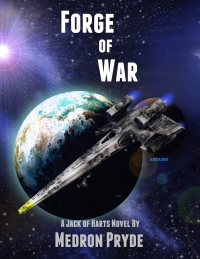
The F-7 Hellcat starfighter entered service five decades after Contact, after we’d had time to learn more about the alien gravitic technologies quickly taking over both military and civilian starship design. She was designed and built by the best gravtech engineers of the time to be the best starfighter ever built. They succeeded. The Hellcats soon replaced the older Blackhawks as the primary American starfighter and proved themselves throughout the Outer Colonies until The War came upon us all. Then they proved themselves again by taking down more alien starfighters than any other Terran fighter. Their frontline service ended with The War, but they continue to serve in system defense fleets, corporate security forces, and private hands throughout the Western Alliance and beyond.
There was another use for Pre-Contact projectiles. A particularly ruthless warship commander could stay outside conventional rocket range and fire the projectiles at stationary targets. Planets or space stations are examples of this. Accuracy was the common problem of these “bombardment” tactics though, and “accidentally” blowing up a civilian compound was a particularly bad way to get oneself declared persona non grata from any civilized star system. Therefore the most effective tactic against prepared planetary defenses was also the most dangerous to use as it was never officially sanctioned by any major government.
We live in a spiral galaxy. The galactic arms spiral around the core, spreading out the further away they get. And the stars filling those arms make interstellar travel possible. Literally. We couldn’t do it without them. Think about it. Yeah, you see what I did there, don’t you? Heh. The serious point is, it’s the gravitic pull of the stars that makes hyperspace work. It’s like on Earth. You can travel from Old Japan to America in a rowboat if you find the current. That’s hyperspace. We follow the currents. But there are no currents to follow when you leave the stars behind.
The end of Twilight’s season three became a virtual tour of Los Angeles and Hollywood, filmed on location with real residents becoming extras in most scenes. The finale was a running battle from the Hollywood Walk of Fame to the Queen Mary. Ending on the edge of the physical and cybernetic landscapes, the gang tried to stop both the Rogue AI and the terrorists from completing their missions. They stopped the Salafis and captured their rolodex of other terrorist cells, but the Rogue AI managed to deploy it’s computer virus before escaping into the unregulated Pacific network. The season ended with Los Angeles itself fading to black, one block at a time.
The primary weakness of projectiles in combat was that they were fired in a certain direction at a certain speed and their ability to modify either course or speed was limited. All a warship had to do was maneuver away from their projected course and it would never have to worry about being hit. That meant warships had to fire at short range to stop the enemy from having time to maneuver away. Most Pre-Contact space combat was a matter of tanks at ten paces blazing away at each other in hopes of cracking enemy armor for the lasers to burn away before being cracked themselves.
Forge of War on Amazon
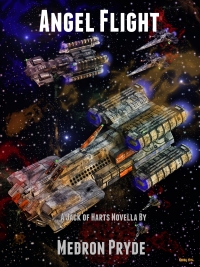
Angel Flight on Amazon
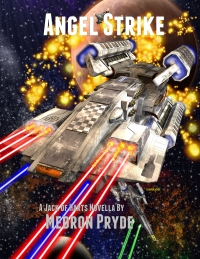
Angel Strike on Amazon
Angel War on Amazon
Wolfenheim Rising on Amazon
Wolfenheim Emergent on Amazon