Cannon Air Force Base housed many of the Air Force’s intelligence, surveillance, and other special operations units in the decades leading up to the Second Great Depression. They built the reputation of doing the hard missions when the orders came in, and their drones, Ospreys, and various C-130 variants flew all over the southern United States every day. They watched over the Old Border between Mexico and the United States, intercepted drug shipments, or simply guarded the southern skies from approaching threats. And many of the Special Forces commands that ravaged the various drug cartels often launched from Cannon AFB. So when the President of the United States needed a difficult job done, he called on Cannon to get the job done.
Today makes nine years since I first started publishing Jack of Harts. I was writing before that, of course. I’ve been writing various fan fictions from Transformers to BattleTech for most of my life, in fact.
But always in the back of my mind I’ve had this idea of the Peloran Confederation. It was a confederation of good guys, human but not from Earth, led by an Admiral Aneerin, who fought to protect everybody he could. Despite the humanity of the main man, it was always a bit of an alien concept, and one that was enjoyable to create in the mind of the child I was when he first came about, but he was hard to truly write about. Who would have thought that telling compelling stories about a basically immortal man with abilities beyond the ken of mortal men, and the greatest fleet and technologies in this galaxy and beyond, all at his disposal in his mission to protect everything and everybody would be difficult? Not the ten year old me who first thought him up, that is for certain.
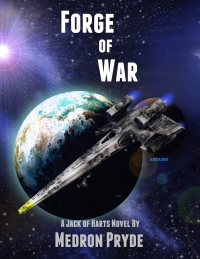
But, oh around ten years ago, I finally decided it was time to take those stories of the Peloran Confederation I always wanted to tell, and make something of them. I decided I was ready to write stories and sell them, and so I took everything I had learned from a decade or two of writing stories and started Forge of War. It was from the perspective of one human from Minnesota, caught up in a War he did not fully understand between galactic factions he did not even realize existed. The Peloran Confederation and their allies became a far distant realm, with Aneerin having only a small force to aid the Earthborn humans who were the primary protagonists. THAT is a story that is easy to write.
The name of my main character was Jack. His first name was easy. I like to find names that fit the personality of the character I’m writing, and Jack is so very… well… Jack. 😉 The final name came about after exhaustive searches for copyrights and available Internet domains. Existing characters in literature wiped out one possibility after another. It seems a lot of people like to write characters named Jack. Hehehe. There were a lot of possible names or descriptors Jack could have had, but in the end I settled on one that nobody appeared to have ever used before if my searches were to be believed. Certainly never published by any publishing house I could find.
Jack of Harts. At jackofharts.com of course. Because it was available and I could buy it.
And nine years ago, I posted my first little snippet in Jack of Hart’s voice. Every day since, for the last nine years, there has been a post on jackofharts.com. Sometimes previews of stuff I am working on, sometimes my own reflections on the world around us. Usually something in the voice of one of the characters I write, describing their world far in our future. Their diary entries as I like to think of them.
These posts helped to introduce people to the world of Jack before I published Forge of War, and I’ve published at least one story a year on Amazon and other services ever since. Including a total rewrite of Forge of War itself. I’ve got several stories waiting for publishing right now, in fact. The conclusion to the Wolfenheim story is nearly done, while I’ve completed several short stories, which are ready or nearly ready for publishing. One is awaiting a cover. Others are awaiting final editing passes. The joys of self-publishing.
It’s been a good nine years, and I’ve learned more about writing stories than I ever expected when I started. I thought I knew it all back then. I thought I was ready. Hah. And again, I say… hah! It has been a wild ride, and I’m a better writer now than I was then. And I greatly hope I can say, nine years from now, that I am a better writer than I was nine years ago.
To nine years of Jack. I have enjoyed them all. To nine more years of Jack. I look forward to seeing what they bring. And should I manage to succeed in my life-long ambition of living forever, maybe I can add a few more nines of years to that little forward-looking toast.
When America returned to space after the Second Great Depression and the Cybernetic Wars, Kirtland Spacebase became Los Alamos Laboratory’s primary launch facility. Kirtland housed the most advanced aerospace craft some of the smartest scientists in the world could design and build, and their exploration ships were found, or not found when they did not wish to be, all over the solar system by the end of the century. The advent of hyperdrives gave Kirtland Spacebase a new mission. It became a vital secure link between Los Alamos and the distant stars, and even Kirtland lost track of how many scientists went into space aboard their rockets. What exactly qualified someone to call themselves a scientist was unclear in those heady days of space exploration, after all. Even Kirtland did not know, and simply went with the flow. If they could afford to buy passage on a shuttle headed out to the orbital stations or beyond, they could fly from Kirtland. After the requisite background checks, of course.
Kirtland Air Force Base did not swear renewed loyalty to the reformed United States Federal government after the Convention of States ended their session. They also did not join the new Republic of Texas. Their relationship with Los Alamos Laboratory had deepened during the Second Great Depression, and Kirtland chose to remain with them as America recovered. But there was still the Cybernetic Wars, the Islamic Jihad, and the Red Chinese to deal with as the years went by, and Kirtland eagerly sent their men and women out to support the various American States and the Feds whenever their help was called for. They even released their nuclear weapons for use against the Chinese and the Rogue AIs in the end. The strike against the Chinese fleet in Indonesia was called off after the discovery of the Singapore Collective, and what history books even admit that there were nuclear weapons in theatre say they were never used against Singapore. The history books are wrong. Small, tactical, nuclear weapons are impressively effective against cybernetic targets after all.
The Second Great Depression was a difficult time for all of America. Some States and cities collapsed entirely. And their own soldiers and commanders abandoned some military bases. Kirtland Air Force Base was not one of them. They were a high-tech center of new research and weapons linked directly with Los Alamos Laboratory by an underground highway and a common mission. To keep their weapons and knowledge from falling into the hands of those who would betray their fellow Americans. That mission is why Kirtland stood with the Convention of States that Texas called to deal with the Federal government once and for all. Evidence collected during the Drug Wars pointed to Federal involvement with the drug cartels that attacked Texas and the other States. The Convention debated how to deal with the new President, any one who followed his orders, and the Federal power structure that had made it possible. Kirtland was one of the many military bases that supported the Convention’s final decision on how to do that.

Forge of War on Amazon
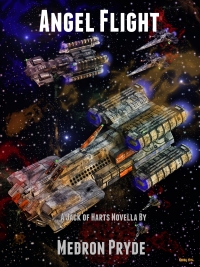
Angel Flight on Amazon
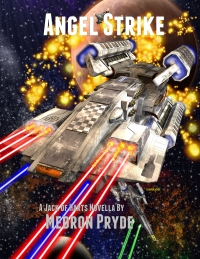
Angel Strike on Amazon
Angel War on Amazon
Wolfenheim Rising on Amazon
Wolfenheim Emergent on Amazon